<img height="1" width="1" style="display:none;" alt="" src="https://px.ads.linkedin.com/collect/?pid=3906484&amp;fmt=gif">
 

VOTING METHODS

Ranked Choice Voting Software for Board and Member Elections

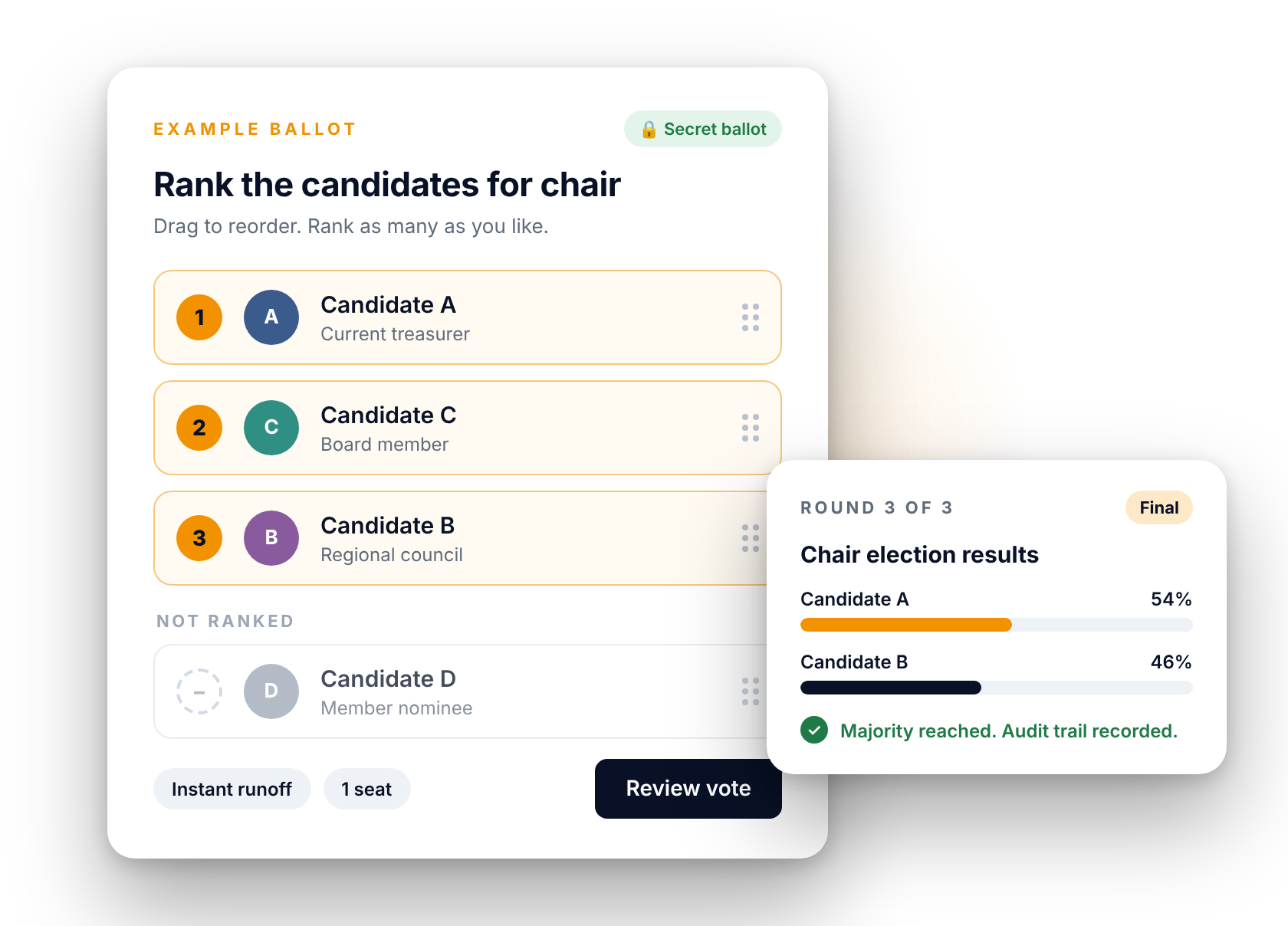
Run ranked choice voting online with Lumi Elections. Voters rank candidates in order of preference, and results reflect their full choices without a second round of voting.

✓Single-seat and multi-seat ranked elections

✓Round-by-round results, shared when your rules allow.

✓Secret ballots and a full audit trail
Plan my voteSpeak to an expert

Example ranked choice ballot in Lumi Elections with round results

Trusted by organizations whose elections have to stand up to scrutiny

Member organizations

Rotary
FIA
National Association of Realtors
World Sailing

4k+ meetings and elections

Delivered by Lumi Global every year.

DEFINITION

What is ranked choice voting?

Ranked choice voting lets each voter rank candidates in order of preference. If no candidate wins a majority of first choices, the candidate with the fewest votes is eliminated and those ballots move to each voter's next choice. Counting continues until one candidate has a majority. For several seats, single transferable vote uses the same ranked ballots.

BEST FOR

Board and council electionsMulti-seat electionsAvoiding run-off votes

HOW VOTES ARE COUNTED

How does ranked choice voting work?

Each time a candidate is eliminated, their ballots move to the voter's next preference, until one candidate has a majority.

Illustrative example: one seat, four candidates

Round 1

Candidate A
  
38%
Candidate B
  
30%
Candidate C
  
22%
Candidate D
  
10%

No majority. Candidate D is eliminated and D's ballots move to the next preference.

Round 2

Candidate A
  
41%
Candidate B
  
33%
Candidate C
  
26%
Candidate D
 
–

Still no majority. Candidate C is eliminated.

Round 3

Candidate A
  
54%
Candidate B
  
46%
Candidate C
 
–
Candidate D
 
–

Candidate A wins with 54% of active ballots.

TYPES

Two types of ranked choice voting

Ranked choice voting, also called preferential voting, is counted in one of two ways, depending on how many seats you are filling.

01

Instant runoff voting (IRV voting)

For a single seat. The candidate with the fewest votes is eliminated each round until one candidate has a majority.
02

Single transferable vote (STV voting)

For several seats. Candidates who reach the quota are elected and their surplus votes move to the next preference. If no one reaches the quota, the lowest candidate is eliminated.

USE CASES

When organizations use ranked choice voting

Common wherever several candidates compete for one or more seats.

COMPARE

Ranked choice voting vs plurality voting

How a ranked voting system compares with a plurality vote when several candidates stand.

 RANKED CHOICE VOTINGPLURALITY (SINGLE CHOICE)
What voters doRank candidates in order of preferenceChoose one candidate
Who winsA majority (one seat) or the quota (several seats), after counting rounds.The candidate with the most votes, even without a majority
Second roundNot neededNeeded if your rules require a majority winner
Several seatsSupported with STVNeeds separate votes or block voting

CHOOSE THE RIGHT SOLUTION

Ranked choice voting with Lumi Elections

Lumi Elections is the ranked choice voting system for ballots run over a set voting window.

Lumi Elections

AVAILABLE

STANDALONE ELECTION

Ranked choice and STV elections, self-service or fully managed.

Explore Lumi Elections →

The Lumi Platform

NOT AVAILABLE FOR THIS METHOD

LIVE MEETING

For votes during a meeting: resolutions, polls, weighted and proxy voting.

Explore the Lumi Platform →

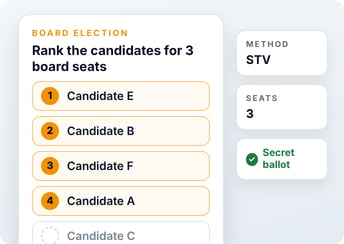
A ranked ballot in Lumi Elections

Ranked ballot for a three-seat STV board election in Lumi Elections

Voters rank candidates in order of preference, and Lumi Elections counts every round for you.

SETUP AND RESULTS

Set up the ballot, then follow every round

Everything a ranked choice voting tool should handle, from the ballot rules to the final count.

01

Ballot rules

Number of seats, how many preferences voters can give, and tie-break rules.
02

Round-by-round results

Transfers and eliminations in each round, counted automatically and ready to share when your rules allow.
03

Full audit trail

Every ballot and every counting step recorded for scrutiny, whether you run a secret ballot or an end-to-end verifiable election.

SECURITY AND TRUST

Secure ranked choice elections, independently tested

Fully managed elections receive annual ISAE 3000 Type 2 assurance, are certified at the ENS High category and are end-to-end verifiable. Self-service elections are certified to ISO/IEC 27001, 27017 and 27018 and ISO 9001. Every product is penetration tested by independent, CREST-approved specialists.

01

Access and authentication

Unique codes, email or SMS links, or ID-based credentials for every eligible voter.
02

Results and records

Results are final the moment voting closes and published when your rules allow.
03

Verified results

Fully managed elections are end-to-end verifiable, with cryptographic proof of the results.

VOTING METHODS

Explore other voting methods

Every vote follows the method your rules define.

Majority and threshold votes

Decide by simple majority or a custom threshold.

Candidate elections

Elect one or more candidates under defined rules.

Weighted voting

Give each voter the weight your rules assign.

Resolution voting

For, against or abstain on formal proposals.

Secret ballots

Keep each choice separate from the voter's identity.

FREQUENTLY ASKED QUESTIONS

Questions about ranked choice voting software

Plan your next ranked choice election

Tell us about your election and a Lumi Global specialist will recommend the right setup.

TALK TO A LUMI GLOBAL EXPERT

Discuss your election

Tell us about your election and a Lumi Global expert will show you how online ranked choice voting could run it.

  • A specialist who understands ranked and STV elections
  • Advice on the right setup for your ranked election
  • A walkthrough of the ballot, counting rounds and results

Share a few details below