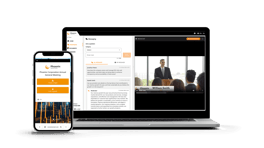

The hybrid AGM is no longer defined by who can access the meeting. It is defined by whether every shareholder, wherever they are, can participate on equal terms.
Hybrid AGMs are now embedded in governance practice across most markets. The format itself is no longer the conversation. What has shifted is the standard it is judged against.
For many organizations, providing a livestream and remote voting access felt like a significant step forward. In 2026, that is no longer enough. Shareholders increasingly expect materially equivalent participation rights whether they attend in person or join online. And governance teams that have not caught up with that expectation are starting to feel the scrutiny.
What participation equivalence actually means
The principle sounds straightforward. In practice, it raises the operational bar considerably.
Participation equivalence means remote shareholders can ask questions live, submit and amend votes in real time, see resolutions as they are discussed, and access supporting documentation as proceedings unfold. Not after the meeting. During it.
Pete Fowler, COO of Lumi Global, says the clearest lesson from markets where hybrid AGMs are most established is that participation rights must be treated explicitly, not implicitly. Organizations that get this right are very clear in their governing documents and notices of meeting about exactly what remote shareholders can expect and how they can exercise those rights.
No one format should deliver a better or lesser experience. That principle is becoming the measure by which hybrid AGMs are judged.
Why the scrutiny is intensifying
Shareholder expectations have not just evolved, they have sharpened. AGMs are being used to ask more focused, more challenging questions than they were even a few years ago. ESG, executive pay and increasingly AI governance are drawing sustained attention.
At the same time, in-room attendance has declined in many markets while online participation continues to grow, often bringing in shareholders from a much wider geographic base. The result is that the quality of the remote experience matters more than it ever has and weaknesses in hybrid delivery are more visible than before.
In 2026, preparedness will be defined less by turnout alone and more by how effectively organizations support meaningful shareholder engagement across every format.
Q&A management: Structure without suppression
One of the most sensitive elements of any AGM is how questions are handled.
Effective hybrid AGM platforms must support:
- Accurate capture of written and live questions
- Clear categorisation of similar queries
- Transparent presentation workflows
- Structured moderation with audit trails
Technology should support engagement, not filter it.
As question volumes increase, thematic grouping tools and AI-assisted categorisation help boards address more issues within limited time, while preserving shareholder voice.
When Q&A workflows are structured and transparent, scrutiny is managed. When they are unclear, trust is tested.
Planning your next AGM?
Download our "Preparation for Governance Teams" whitepaper for expert insight on what governance teams need to prepare across AGMS, elections, investor relations and member meetings

The areas where hybrid AGMs most often fall short
Three operational areas come under the most pressure in hybrid delivery: Q&A management, real-time vote transparency, and audit-ready reporting. Weakness in any one of them erodes confidence quickly.
Q&A is the most sensitive. How questions are handled, whether shareholder voices are preserved, whether moderation feels fair, whether written and live questions receive equal treatment is where trust is most easily lost. Technology should support engagement, not filter it. When Q&A workflows are structured and transparent, scrutiny is managed. When they are unclear or opaque, it is noticed.
Vote transparency is the other area where expectations are moving fast. There is growing momentum toward sharing voting results during meetings rather than only after they close. The implications for platform infrastructure are significant and organizations that cannot support this seamlessly will face friction at exactly the moment scrutiny is highest.
The whitepaper goes into detail on what best practice looks like across each of these areas, and what governance teams should be asking of their platforms and providers in 2026.
A practical checklist before your next AGM
Before going live, ask:
- Can remote shareholders participate in real time, not just observe?
- Is Q&A handling structured, transparent and auditable?
- Can voting results be displayed during the meeting?
- Is your audit trail defensible and independently verifiable?
- Are participation rights explicitly set out in your notice of meeting?
If the answer to any of these is uncertain, now is the time to review your infrastructure. Hybrid expectations are rising and tolerance for operational friction is falling.
Frequently asked questions
Q. What is participation equivalence in a hybrid AGM?
A. The principle that remote shareholders have materially the same rights as those attending in person, including the ability to ask questions, vote in real time, and access documentation during the meeting. It is increasingly the standard by which hybrid AGMs are judged.
Q. Are companies required to show live voting results?
A. Requirements vary by region, but there is increasing expectation for greater in-meeting transparency, and organizations that provide it are better positioned to maintain shareholder confidence.
Q. How is AI used in hybrid AGMs?
A. AI is improving operational speed across transcription, minute generation and question categorization — reducing administrative strain without compromising governance standards. The key is integration into structured workflows rather than bolting it on as an afterthought.
Q. What makes a hybrid AGM platform governance-ready?
A. Structured Q&A management, secure real-time voting, full audit trails, equivalent participation rights for remote attendees, and the ability to support pre-meeting engagement workflows.